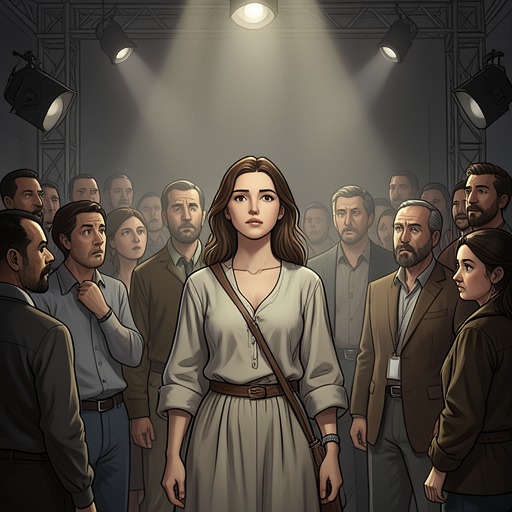
Brianna defeats Milez at the Ring Rookie Royale
On the Come UpBrianna defeats Milez at the Ring Rookie Royale is the battle in which Brianna Jackson turns a faltering debut into a public breakthrough. The contest tests more than her ability to rhyme: Milez’s verse weaponizes the murder of her father, but Brianna ultimately answers him by challenging his authenticity and asserting her own voice. Her win makes the Ring recognize her as a formidable rapper, even as the episode exposes the personal and social pressures behind the performance.
The Rookie Royale and the Stakes
The contest begins when Hype announces that two rookies will battle for the first time in the Ring. Brianna is introduced after a drumroll, and Aunt Pooh raises her arm and leads her forward, announcing her as the champion. The gesture offers a show of confidence, but Brianna is frightened; she climbs into the ring beneath the spotlight while hundreds of faces and phone cameras turn toward her. The contrast between the public certainty of Aunt Pooh’s introduction and Brianna’s private fear establishes the emotional risk of a first performance before a crowd.
Brianna has already seen how sharply the Ring can judge a rapper. Earlier, Ms. Tique’s punch lines draw a reaction from the crowd and win her first two battles decisively. That standard helps explain why Brianna understands that losing would follow her beyond the contest. She is not simply trying to make it through a performance: she must establish that she belongs in a setting where the audience rewards verbal force and remembers failure.
Milez’s First Round and Brianna’s Blank
Milez opens with a boastful verse about wealth, expensive cars, guns, and a supposedly dangerous life. Brianna recognizes that his claims do not fit what she knows: he lives in the suburbs with Supreme, yet raps as if he represents the street life he describes. The gap between his persona and his circumstances becomes an opening for her criticism, but his next attack changes the terms of the battle. He says he will murder her like someone murdered her father, Lawless.
The reference to her father’s killing breaks Brianna’s concentration. When the beat returns for her turn, the lines she had prepared disappear, and she can only repeat Milez’s words about murdering her and her father. Someone in the crowd shouts that she choked; the response spreads into a chant, while Milez grins and his father chuckles. Hype stops the beat and awards Milez the first round automatically. Brianna stumbles back to her corner, aware that she has blanked. The loss is not merely a weak opening: an intimate bereavement has been turned into a public taunt, and the crowd’s reaction compounds the humiliation.
Reclaiming the Battle
Milez continues, but his next round earns only a few cheers. Hype then gives Brianna the floor. At first, she has to assemble her scattered ideas, fitting them together while the beat plays; the scene reverses the earlier blank, showing her finding a way through the disruption rather than pretending it never happened. Once the words come, she makes his borrowed image the target of the battle.
Brianna calls Milez a writer’s biter and directs the audience’s attention to Supreme, challenging the relationship between the rapper’s claims and the person who helped shape him. She contrasts his money with her greater skill, invokes the Garden, and turns his missing heart into the image of a face on a milk carton. Instead of trying to outdo his gangster posturing on its own terms, she attacks the credibility of the role he performs. The crowd erupts; even listeners who had watched her stumble respond to the force of the verse. Hype declares her the winner of the round, and Brianna grins, recognizing that she has got him.
The outcome is confirmed through the judges’ vote. Mr. Jimmy and Dee-Nice hold up signs for Brianna, while CZ votes for Li’l Law. Hype announces Brianna as the winner of the Rookie Royale and raises her arm amid thunderous cheers. The decision settles the contest despite the split vote, transforming her first-round collapse into a victory earned through recovery and a more effective attack.
What the Victory Establishes
Aunt Pooh’s support frames the battle from the beginning: she leads Brianna into the Ring and later celebrates her success. The crowd’s change of response, from chanting over Brianna’s blank to cheering her later verse, makes the victory a public reversal as well as a judges’ decision. The match establishes that Brianna can lose her place under pressure and still regain command of the performance; her eventual success depends not on denying the painful subject Milez raises, but on returning to the contest with language of her own.
The win also sharpens the conflict between performance and identity that follows Brianna beyond the Ring. At the battle, she identifies Milez’s claims as an adopted pose and punctures it by invoking Supreme. Later, Supreme advises her to play whatever role people expect, while also warning her not to become that role. Brianna’s response to Milez foreshadows the tension: she can use sharp performance to expose another person’s manufactured image, but the music industry and the public will also try to make her lyrics stand for her entire identity.
That pressure is shaped by her position as a Black teenage girl trying to enter a male-dominated rap scene. Aunt Pooh has warned that Brianna will have to do twice the work for half the respect, remain as cutthroat as the men, and avoid showing weakness. Brianna later confronts a dismissive question about whether she will rap nursery rhymes by answering with a joke that wins the room over. The battle similarly shows that acceptance is not granted in advance: she must demonstrate skill in front of a crowd that has already seized on her mistake. Her success is therefore both an artistic achievement and a pointed refusal to let a vulnerable moment define her.
The Battle’s Later Echo
Brianna’s victory gains significance as her song becomes controversial. A television report identifies her as the local rapper behind “On the Come Up” and describes the track as violent and popular among young listeners. Later, during an interview, Hype challenges lyrics that he says suggest she is armed and might kill police officers. Brianna rejects that interpretation and points out the gendered double standard in his reaction: he was not surprised when her father rapped about such material as a teenager, but her age and sex change how her words are received. The battle’s original confrontation with Milez thus anticipates the broader dispute over who is permitted to perform aggression, and who is treated as if a performed voice reveals an essential character.
When Supreme later presses Brianna to record a song written by Dee-Nice, she refuses to become a puppet or claim someone else’s words as her own. Supreme explains that he once urged Law to adopt a street image and associate with the GDs in order to seem authentic; he says Law took the pose seriously. He urges Brianna to play the role without becoming it, describing her as a chance to do differently from what he and Law managed. That history adds weight to Brianna’s Rookie Royale verse: calling out Milez’s borrowed persona is an early instance of the same demand for authenticity that she later makes of the adults trying to manage her career.
The clearest later expression of that demand comes in Brianna’s freestyle at The Ring. She refuses to be a joke, a pet, a puppet, or a clone, and presents herself as a daughter, sister, hope, and mirror rather than a sellout or a thug. She also challenges listeners who treat rap as proof of the violent identity they expect her to embody. The Rookie Royale is not yet that fully articulated declaration, but its decisive move is already present: Brianna turns the battle away from the role Milez performs and toward the truth of who is speaking. The cheers that crown her victory mark the beginning of her emergence as a rapper whose strongest weapon is not imitation but authorship.